October 6, 2026 • Edited by Alexandr Jirgens
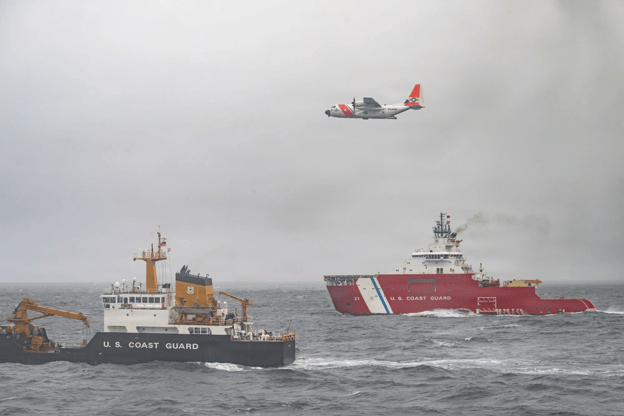
U.S. Coast Guard cutters Fir and Storis operate with an HC-130 aircraft during Tundra Merlin in the Bering Sea, July 21, 2026. Photographed from HMCS Max Bernays. Photo: Sailor 1st Class Jordan Schilstra, Canadian Armed Forces, via DVIDS.
Despite recent trade tensions, the United States and Canada have continued cooperating on Arctic defense, including operations in the Alaskan frontier.[1] Alaska’s defense rests on a demanding practical question: can American and allied forces reach the right place, share reliable information, and act together? Operation Tundra Merlin offers a window into how commanders are addressing that problem. Its recent activities brought Canadian airlift, American ground-based precision fires, combat aircraft, ships and a submarine into coordinated operations. Our assessment is that the campaign’s significance lies in connecting these capabilities across a difficult theater.[2]
On July 31, 2026, U.S. Northern Command deployed an M142 High Mobility Artillery Rocket System, or HIMARS, from Joint Base Lewis-McChord, Washington, to Nome, Alaska, aboard a Royal Canadian Air Force C-17. The aircraft also collected participating soldiers at Fort Wainwright. The deployment demonstrated a concrete contribution from Canada: transporting American combat equipment and personnel into western Alaska.[3]
Training near Nome on August 4 and 6 combined HIMARS and an AN/TPQ-53 radar with F-35 and F-16 fighters and a KC-135 tanker. According to Alaskan Command’s official account, F-35s and HIMARS coordinated against a simulated target approximately 135 miles away, while F-16s intercepted aircraft representing incoming threats. The activity exercised offensive and defensive tasks within one integrated mission.[4]
A September maritime scenario extended this approach into the Bering Sea, a region of strategic competition involving the United States, Russia, and China.[5] A military release, reproduced by True North Strategic Review, reports that U.S. and Canadian forces conducted simulated maritime strikes between September 18 and 22. A Canadian CP-140 patrol aircraft and HMCS Corner Brook submarine tracked a Coast Guard cutter acting as a target and relayed information for a simulated strike. Other participating assets included F-35s, an E-3 warning-and-control aircraft, a tanker and surface vessels.[6]
These activities continued an existing campaign. Alaskan Command documented Tundra Merlin maritime-strike training in the Gulf of Alaska on December 9, 2025. The summer and September events therefore represent further demonstrations within an ongoing effort. Their occurrence establishes that forces practiced together; commanders’ claims about stronger deterrence remain assessments rather than independently measured outcomes.[7]
The strategic setting helps explain the emphasis on cooperation. The Pentagon’s 2024 Arctic Strategy identifies growing Russian–Chinese collaboration, environmental change and weaknesses in supporting infrastructure as challenges. It calls for better Arctic capabilities, closer engagement with partners and exercised military presence. The document also emphasizes communications, surveillance and equipment suited to the environment. Tundra Merlin’s activities are consistent with that approach.[8]
There is a legitimate historical connection. During the Cold War, the United States and Canada developed northern radar networks, including the Distant Early Warning Line, completed in 1957. Their continental-defense cooperation helped establish NORAD in 1958. The parallel is institutional: geography demanded shared warning and coordinated action. Today’s mobile precision fires and maritime targeting involve different missions, technologies and threats. The earlier experience nevertheless illustrates the enduring importance of arrangements that allow partners to operate together.[9]
VVV’s judgment is that repeated integration could give commanders more usable response options. Its value would depend on whether forces can sustain those options when supplies, communications or operating conditions deteriorate. The public accounts cited here do not establish permanent force growth, readiness for every winter condition, or performance against an adversary disrupting communications and resupply.[10]
The next developments worth watching are repeated deployments, sustained logistics support and evidence that targeting information remains reliable under disruption. Those would help distinguish a successful rehearsal from an enduring operational capability. Tundra Merlin provides evidence of deliberate joint U.S.–Canadian preparation; its lasting strategic value will depend on how consistently that preparation can be translated into action and sustained defense cooperation between the United States and Canada.
Notes
[1] Canada, Department of Finance, “Complete List of U.S. Products Subject to Counter Tariffs,” Government of Canada, updated August 26, 2026, accessed October 6, 2026, https://www.canada.ca/en/department-finance/programs/international-trade-finance-policy/canadas-response-us-tariffs/complete-list-us-products-subject-to-counter-tariffs.html.
[2] U.S. Northern Command, “HIMARS Deploys to Arctic under Operation TUNDRA MERLIN,” July 31, 2026, https://www.northcom.mil/Newsroom/Press-Releases/Article/4561968/himars-deploys-to-arctic-under-operation-tundra-merlin/; Christopher Chen, “Joint Force Demonstrates Integrated Air, Land Capabilities for Arctic Homeland Defense,” Alaskan NORAD Region/Alaskan Command/11th Air Force, DVIDS, August 7, 2026, video and accompanying description, 1:16, https://www.dvidshub.net/video/1017929/joint-force-demonstrates-integrated-air-land-capabilities-arctic-homeland-defense; Alaskan Command Public Affairs, “U.S., Canadian Forces Conduct Maritime Strike Scenario in Bering Sea,” U.S. Northern Command, September 23, 2026, reprinted in True North Strategic Review, September 24, 2026, https://www.truenorthstrategicreview.ca/p/us-canadian-forces-conduct-maritime.
[3] U.S. Northern Command, “HIMARS Deploys to Arctic.”
[4] Chen, “Joint Force Demonstrates Integrated Air, Land Capabilities.”
[5] U.S. Department of Defense, 2024 Department of Defense Arctic Strategy (July 2024), 2, 4–5, https://www.govinfo.gov/content/pkg/GOVPUB-D-PURL-gpo247765/pdf/GOVPUB-D-PURL-gpo247765.pdf.
[6] Alaskan Command Public Affairs, “U.S., Canadian Forces Conduct Maritime Strike Scenario.”
[7] Alaskan Command Public Affairs, “Alaskan Command Executes Operation TUNDRA MERLIN,” DVIDS, December 11, 2025, https://www.dvidshub.net/news/553802/alaskan-command-executes-operation-tundra-merlin. Chen, “Joint Force Demonstrates Integrated Air, Land Capabilities.” Alaskan Command Public Affairs, “U.S., Canadian Forces Conduct Maritime Strike Scenario.”
[8] U.S. Department of Defense, 2024 Arctic Strategy, 4–7, 9–11, 14–15.
[9] Royal Canadian Air Force, “The Golden Years (1950–1964)—Part 2,” in On Windswept Heights II, Government of Canada, last modified April 21, 2022, https://www.canada.ca/en/air-force/corporate/reports-publications/on-windswept-heights-2/49-history-1950-1964.html.
[10] U.S. Northern Command, “HIMARS Deploys to Arctic”; Chen, “Joint Force Demonstrates Integrated Air, Land Capabilities”; Alaskan Command Public Affairs, “U.S., Canadian Forces Conduct Maritime Strike Scenario”; U.S. Department of Defense, 2024 Arctic Strategy, 9–11.
Bibliography
Primary Sources
Alaskan Command Public Affairs. “Alaskan Command Executes Operation TUNDRA MERLIN.” DVIDS. December 11, 2025. https://www.dvidshub.net/news/553802/alaskan-command-executes-operation-tundra-merlin.
Alaskan Command Public Affairs. “U.S., Canadian Forces Conduct Maritime Strike Scenario in Bering Sea.” U.S. Northern Command. September 23, 2026. Reprinted in True North Strategic Review, September 24, 2026. https://www.truenorthstrategicreview.ca/p/us-canadian-forces-conduct-maritime.
Canada. Department of Finance. “Complete List of U.S. Products Subject to Counter Tariffs.” Government of Canada. Updated August 26, 2026. Accessed October 6, 2026. https://www.canada.ca/en/department-finance/programs/international-trade-finance-policy/canadas-response-us-tariffs/complete-list-us-products-subject-to-counter-tariffs.html.
Chen, Christopher. “Joint Force Demonstrates Integrated Air, Land Capabilities for Arctic Homeland Defense.” Alaskan NORAD Region/Alaskan Command/11th Air Force. DVIDS. August 7, 2026. Video and accompanying description, 1:16. https://www.dvidshub.net/video/1017929/joint-force-demonstrates-integrated-air-land-capabilities-arctic-homeland-defense.
U.S. Department of Defense. 2024 Department of Defense Arctic Strategy. July 2024. https://www.govinfo.gov/content/pkg/GOVPUB-D-PURL-gpo247765/pdf/GOVPUB-D-PURL-gpo247765.pdf.
U.S. Northern Command. “HIMARS Deploys to Arctic under Operation TUNDRA MERLIN.” July 31, 2026. https://www.northcom.mil/Newsroom/Press-Releases/Article/4561968/himars-deploys-to-arctic-under-operation-tundra-merlin/.
Secondary Sources
Royal Canadian Air Force. “The Golden Years (1950–1964)—Part 2.” In On Windswept Heights II. Government of Canada. Last modified April 21, 2022. https://www.canada.ca/en/air-force/corporate/reports-publications/on-windswept-heights-2/49-history-1950-1964.html.
Sources selected and briefing edited by Alexandr Jirgens, with AI assistance in supplementary research and drafting.


Leave a comment